Students
Fast, reliable answers with visible sources, at any hour.
human-supervised ai
A student assistant grounded in the official documents of a degree programme — five checks, three possible outcomes, human approval and automatic re-checking when documents change.
Students of a degree programme ask the same questions every day — enrolment, study plans, internships, labs, exams, credit recognition, exam dates. The answers exist, but they live inside regulations and documents dozens of pages long.
On these topics a wrong answer is not a small inconvenience — a wrong date or an invented requirement can cost a semester. A generic chatbot, capable of "hallucinating" plausible content, was out of the question. So the design question became a different one — how do you build an AI assistant an institution can trust?
Fast, reliable answers with visible sources, at any hour.
Approving, correcting or rejecting AI proposals from a single queue, and keeping an eye on how the service is going.
Receiving only personal cases and uncovered topics, not questions answered by regulations.
Mapping recurring questions and the official documents that cover them, with the people who support students daily.
Definition of the five checks and three outcomes — the heart of the system is the question's journey, not the model.
Two interfaces — the student chat and the control panel with approval queue, questions, answers, documents and trends.
Real operation under supervision, refinement of recurring cases and built-in visual documentation.
The system consists of the student chat, the supervision panel and an engine that treats every question as a case to be processed — with checks in a fixed order and a tracked outcome.
An essential interface with suggested questions, openable citations and clear instructions about what not to enter.
The queue of pending proposals — approve, correct or reject, with answer and document side by side.
A browsable archive of what was asked and the library of approved answers.
The official sources monitored by the system, with confirmation of new versions.
Questions received, outcomes, most requested topics and student feedback.
Operation tracking and access management.
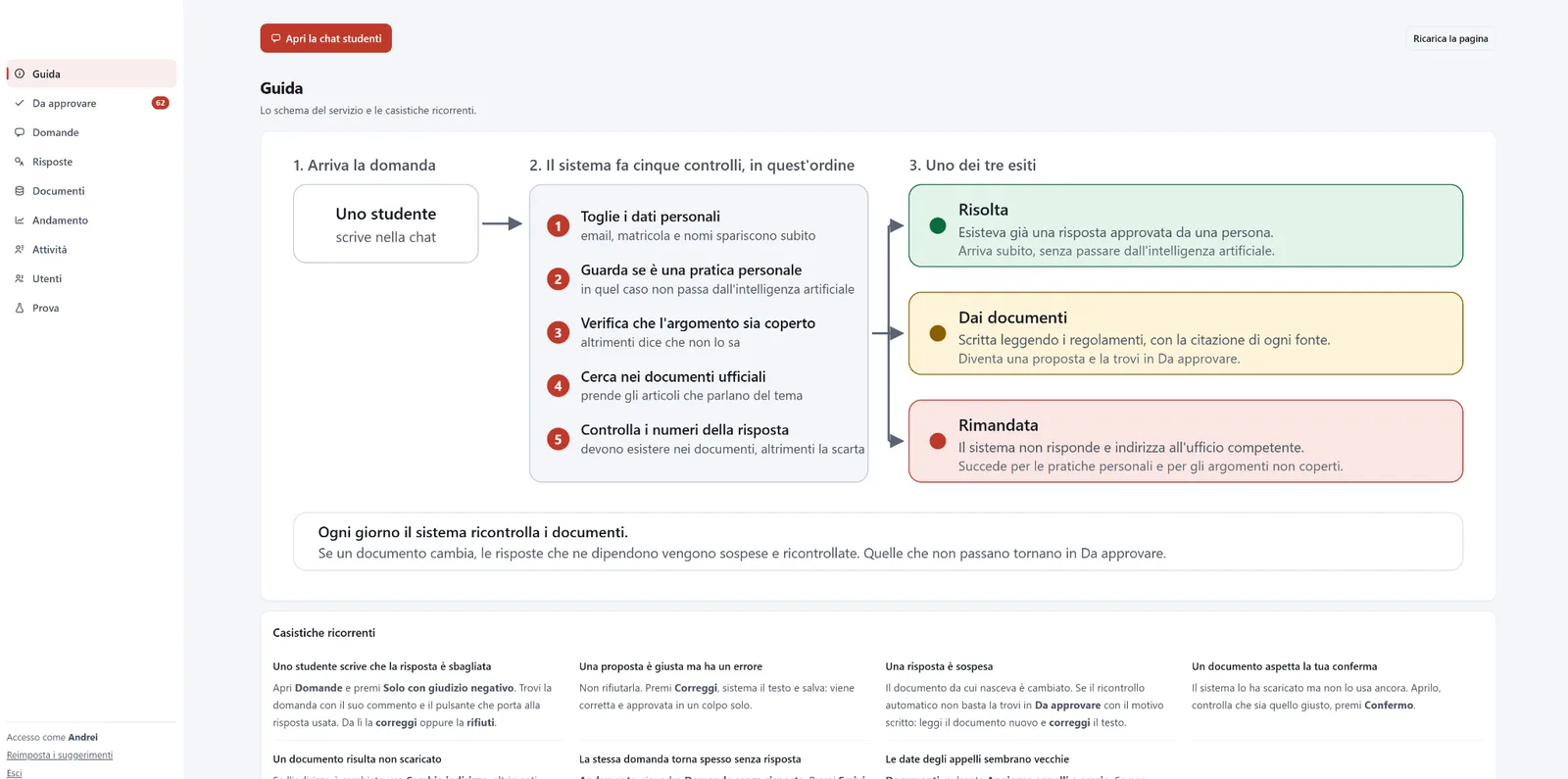
Every question goes through five checks in this order. No step can be skipped, and the outcome is always one of three — tracked.
Emails, student IDs and names are removed before any processing.
If the question concerns an individual case, it never goes through the AI — it goes to the right office.
If the topic is not in the documents, the system says it does not know. It never improvises.
The answer is written by reading the regulations, citing every source.
Dates, amounts and credits must exist in the documents — otherwise the answer is discarded.
Three possible outcomes: Resolved (a human-approved answer already existed — it arrives instantly, without AI), From the documents (a new proposal with citations, entering the approval queue) or Referred (the system does not answer and directs the student to the right office).
The most delicate point of a document-grounded system is time. Every day the system re-checks its sources.
Sources are re-downloaded and compared with known versions.
If a document changed, the answers depending on it are automatically suspended.
Answers that pass the re-check go live again; the others return to the human approval queue.
Every answer shows the documents it comes from, one click away.
Supervision is a three-button flow — correcting a proposal fixes and approves it in one move.
Recurring questions receive the existing approved answer, immediately and without AI.
Volumes, outcomes, top topics and feedback — the service is measured, not assumed.
The recurring supervision situations are explained right inside the panel.
Suggested questions to get started and voice input for those who prefer not to type.
How many internship hours are required in total?
The programme defines a total number of hours in its regulations. You can find the per-year breakdown in the table of the document cited below.
📄 Internship regulations · art. 4 ✓ Answer approved by a personDemonstrative reconstruction of the interface, with fictional data.
Always visible under the input — do not enter personal data, answers do not replace official documents. Trust starts from a clear perimeter.
The first section of the supervision panel is a visual guide to how the service works — supervisors must understand the mechanism to trust the outcomes.
Every question has an explicit, browsable outcome — even "no answer" is a designed outcome, with the right referral.
The correction flow turns supervision from a bottleneck into a quick pass.
Challenge. Language models tend to produce plausible but unfounded answers.
Solution. A double constraint — retrieval over official documents only, plus separate verification of numbers. Without grounding, the system prefers not to answer.
Challenge. Documents change during the academic year, silently.
Solution. Daily re-checking with automatic suspension and revalidation of dependent answers.
Challenge. Students write in a hurry, with typos and wildly different phrasings.
Solution. Questions are normalised and matched to existing approved answers when the topic is the same.
For confidentiality I do not publish service metrics; the image shows the real panel with the university's branding removed.
Tell me about it: the first orientation call is free of obligations.