People on site and in the workshop
Reporting things as they come — a photo, a voice note — without learning any management software.
operations + ai ecosystem
An ecosystem for an exhibition-design studio — field requests become tickets and tasks; one editorial flow becomes content for website and social channels, with AI and a person's final approval.
A studio that designs and produces exhibitions — shows, spaces, events — lives between the workshop and the construction site. Operational requests are born there, in front of a wall to finish — a photo, a thirty-second voice note, a technical document photographed on the fly.
Somewhere on the way to the office, something always got lost. Meanwhile communication — website, social channels, portfolio — remained the postponed task, because it meant redoing the same work six times, once per channel.
The project was born to join the two worlds in a single ecosystem — the public website, the internal digital studio and a direct channel from the field.
Reporting things as they come — a photo, a voice note — without learning any management software.
Seeing every request as a ticket with materials, deadlines and assignments; governing tasks, quotations and documents.
Going from finished project to published content quickly, keeping the studio's voice.
Observing how requests are actually born — on site, by voice, with both hands busy.
Three connected surfaces — public website, internal studio, Telegram bot — on a single base of data and access control.
Modules released in sequence — board and tasks, then tools (CRM, quotations, documents, purchases, sales, invoices), then the multi-channel editorial flow.
The platform grows with the studio — new needs become modules, without breaking what exists.
Three surfaces, one system — the field channel (Telegram), the Studio with its board and tools, and the multi-channel editorial flow feeding website and social channels.
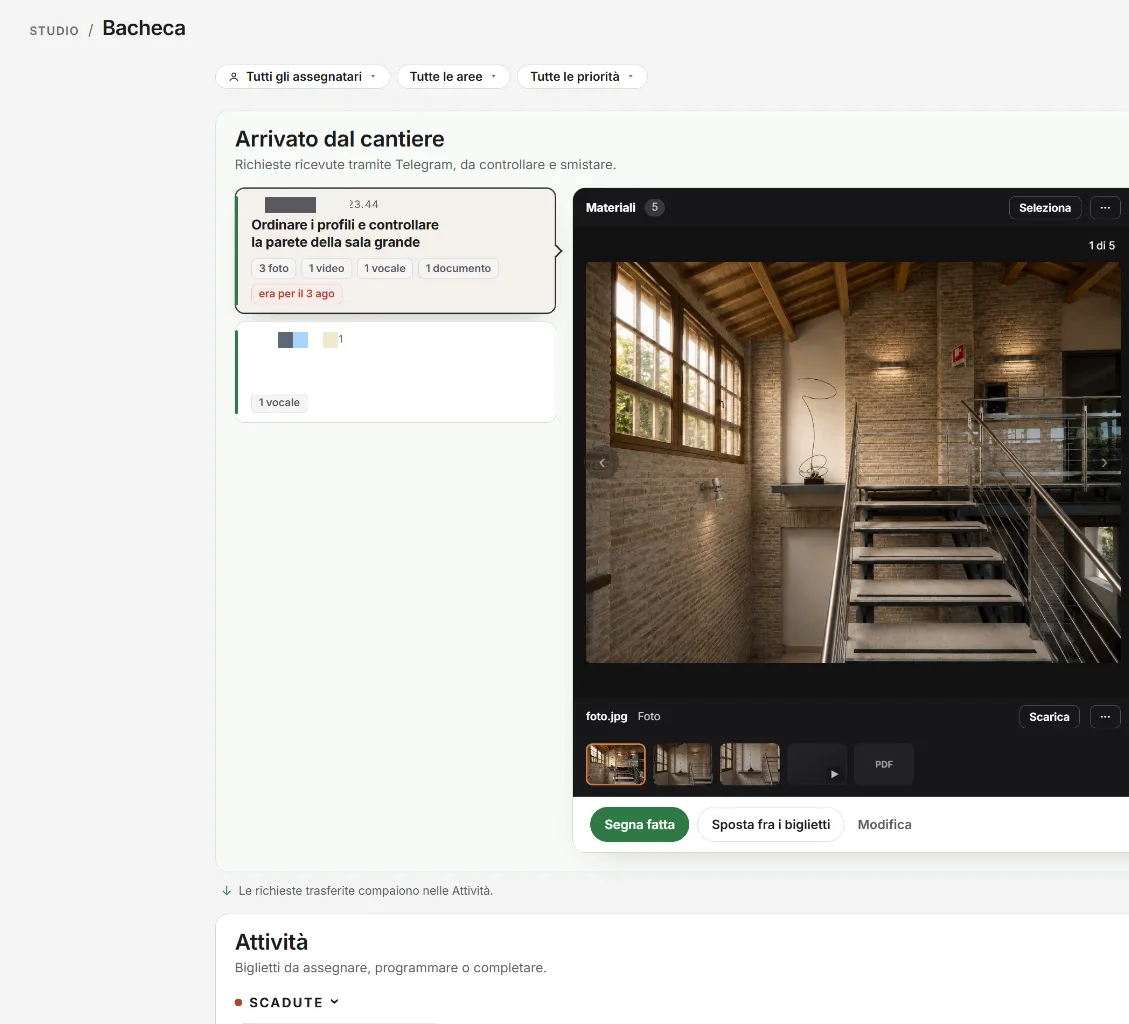
Field requests arrive as tickets with photos, videos, voice notes and documents, to be turned into tasks.
Assignments with deadlines, priorities and areas — what is late surfaces on its own.
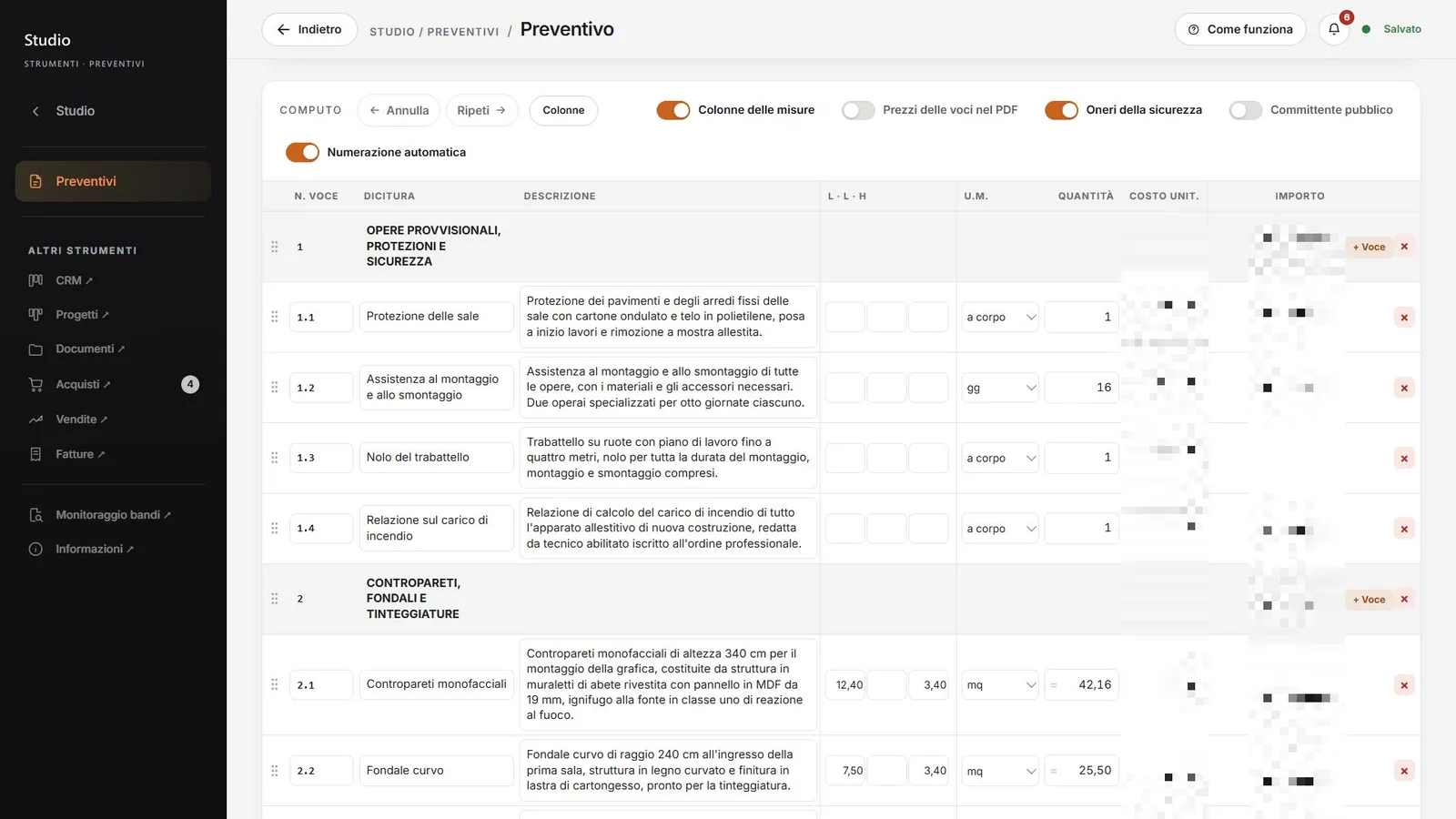
Offers structured by items and chapters, with measures, amounts, automatic numbering and PDF options.
The administrative tools linked to projects, in a single archive.
Sending documents with a personal link and a dedicated signing page for the recipient.
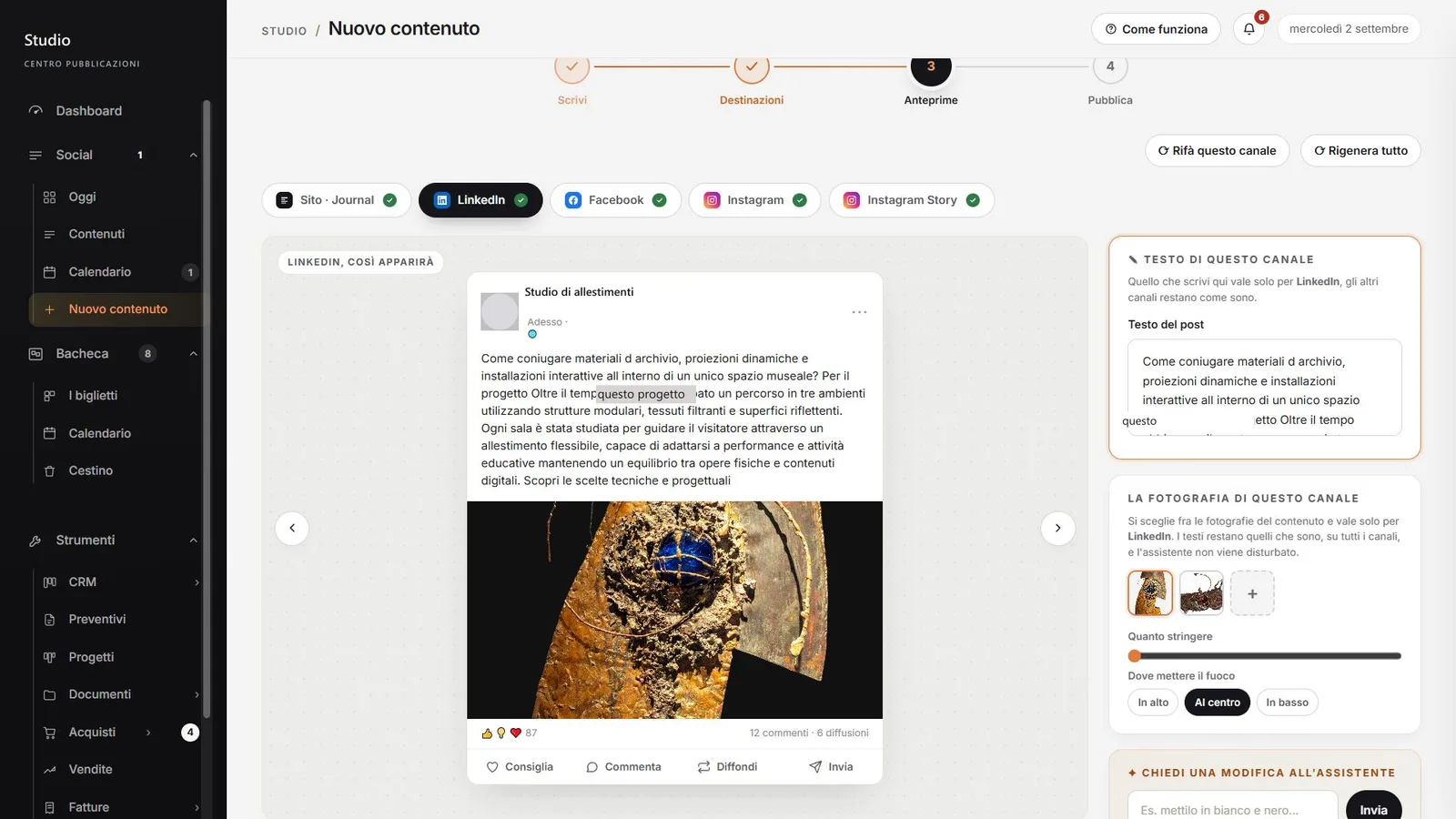
One piece of content, six destinations — website journal and portfolio, LinkedIn, Facebook, Instagram and Stories.
The most important flow is the shortest one — whoever is on site should do nothing different from what they would do in a chat.
Photo, video, voice note, document or dictated text — sent to the studio's Telegram bot.
Voice notes become text; materials stay attached to the request.
The request appears on the board — "Arrived from the site" — with all materials, and a confirmation goes back to the sender.
The ticket becomes an assigned task, with deadline and priority.
The bot replies with a readable confirmation ("The office will find…") — whoever writes from the site knows immediately that the request has landed.
The editorial flow is a four-step path, with AI preparing per-channel versions and a person approving.
Title, story, tone of voice (elegant, professional, warm, direct) and images.
Website journal and portfolio, LinkedIn, Facebook, Instagram, Stories — with toggles and a summary.
AI adapts text and format to each channel; the preview shows the real result — phone included.
Final approval and coordinated publishing to the selected channels.
Photos, videos, voice notes with a player, documents and transcriptions — the request arrives complete, not to be reconstructed.
Items and chapters with measures, units, amounts and automatic numbering; options for prices in the PDF, safety charges and public clients.
The studio's voice is an explicit choice, not an accident — four defined tones for the editorial flow.
A Story is judged on a phone, a post in its own format — before publishing, not after.
For each destination you choose framing, crop and focal point of the images.
Every section has its own "How it works" — the tool explains itself.
For people on site the interface is Telegram — zero training, zero forgotten passwords, zero friction.
Requests are "tickets" pinned to a board, with confirmations written the way a person would say them — the software adopts the studio's metaphors, not the other way round.
No blind publishing — each channel shows exactly how the content will appear, phone included.
Every generated text remains editable and nothing goes out without explicit approval — the last button is always human.
Challenge. Voice notes dictated on site arrive with noise, typos and broken sentences.
Solution. Transcription is a declared starting point — the text stays editable and the office confirms before it becomes a task.
Challenge. Six channels with different formats and tones risked fragmenting the studio's identity.
Solution. Explicit tone of voice, per-channel rules and real previews — consistency is built into the flow, not left to memory.
Challenge. An ecosystem growing for years must not break with every new module.
Solution. Independent modules on a shared base of data and access control, released and tested one at a time.
The images come from the real system, anonymised — names, references and recognisable data are redacted.
Tell me about it: the first orientation call is free of obligations.